You're reading an older article from ELECTRICAL CONTRACTOR. Some content, such as code-related information, may be outdated. Visit our homepage to view the most up-to-date articles.
The workplaces of the world pose multiple hazards to the men and women in the building and construction trades, and there are many different types of personal protective equipment (PPE) to guard the wearer from specific, potentially deadly hazards. Protective gear creates a barrier between the worker and hazards. It does not eliminate any hazard.
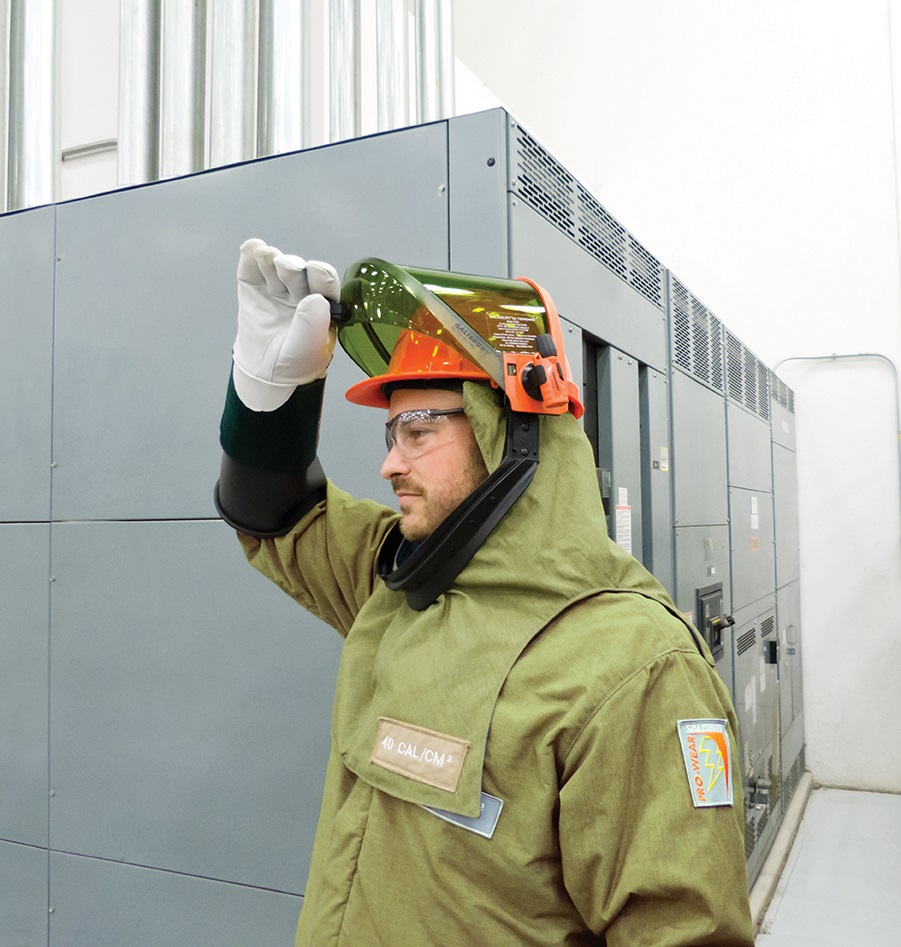
The primary dangers electrical workers face are electric shock and arc flash, and protective gear generally includes rubber gloves, leather keepers, a hard hat, a face shield, and flame-resistant garments that cover the torso, arms and legs.
The correct PPE must fit the environment of the task at hand and be rated to provide protection for the level of risk. Just as important, workers must be trained in the proper use of PPE and instructed to use it when required.
The primary standards used commonly in the United States that address arc flash are NFPA 70E, ASTM F-1506, the National Electrical Safety Code, and the Occupational Safety and Health Administration’s (OSHA) revised 1926 and 1910.269 Subpart V, said Scott Margolin, international technical director for Westex by Milliken.
“Each of these standards covers PPE for electrical workers, including arc- rated flame-resistant clothing,” Margolin said. “In general, this clothing must be wrists to ankles, meaning long sleeves and long pants, and the arc rating should meet or exceed the potential arc incident energy of the equipment being serviced.”
Arc flash and electric shock are different hazards that require different training, approach distances and PPE. Shock protection requires rubber voltage-rated gloves and leather keepers, insulated tools, dielectric boots, and sometimes rubber blankets. It is vital to ensure the rubber gloves are stored properly, checked for damage before use and replaced regularly. Tools must maintain the proper insulation; some brands have a different undercoat color to provide a visual cue that they need to be replaced.
Regarding arc flash, Margolin said that the wording of standards may vary slightly, but the philosophy is that anyone working on energized equipment where there is a possibility of an arc flash must be appropriately trained and wearing arc-rated clothing.
“The vast majority of catastrophic injuries and fatalities related to arc flash are not caused by the flash itself, but rather by the arc igniting flammable clothing. Flammable clothing, including cotton, will then cause injury to a significantly larger skin surface area and also dramatically increase the duration of the thermal hazard from a fraction of a second to many seconds. Conversely, arc-rated clothing will not ignite and continue to burn, and the intent of the standards is that the arc rating of the garment meet or exceed the anticipated arc-incident energy so that second- and third-degree burns are minimized or eliminated by the fabric,” Margolin said.
The garments must be in good repair, free of flammable contaminants, and worn properly (meaning buttoned or zipped up fully, sleeves not rolled up, shirts tucked in). The outer layer must be flame-resistant. Layers must not be meltable (cotton, silk and wool qualify). Other PPE is required, including, but not limited to, hardhat, face shield, safety glasses, voltage-rated gloves, and shoes or boots.
In the past, the heavy, stiff fabric of protective clothing items has been uncomfortable for some workers, tempting them to remove the PPE.
“Product improvements recently have focused on lighter weights, softer and more breathable fabrics, higher arc ratings at a given weight, and revolutionary knit fabrics,” Margolin said.
[SB]“Comfort is a big concern for modern flame-resistant clothing,” said Justin Bost of protective clothing manufacturer Tyndale Co.
“With today’s more comfortable fabrics, workers are less likely to compromise their protection by rolling up sleeves, opening shirt fronts, shedding protective layers or even violating company safety policy in favor of clothing that provides increased comfort,” Bost said. “Style advancements, such as traditional work wear and western flair, have been included in flame-resistant product offerings, and emulation of popular performance sport outdoor brands have been brought to the flame-resistant marketplace.”
David Sklodowski, product marketing manager, Salisbury Electric Safety, said several key products have been launched within the past two years to take electrical PPE to new levels of comfort.
• Next-generation rubber insulating gloves offer improvements in dexterity and pliability to allow electrical workers longer periods of work time with less fatigue.
• Lift-front hoods have significant improvements in airflow, outward visibility and weight reduction, providing an arc-flash protection hood that is not only more comfortable but also safer than the industry standard.
• Premium lightweight 40-calorie arc-flash garments, with more than 30 percent reduction in fabric weight, keep wearers cooler and interfere less with movement.
Equipping workers with the right safety gear begins with selecting the right products. Flame-retardant clothing is assigned an arc thermal performance value (ATPV) rating, which represents the amount of incident energy that would cause the onset of second-degree burns and the amount of protection the clothing provides when an electrical arc comes in contact with the fabric. Clothing must be designed to meet ATPV rating minimums throughout the life of the garment—clothing must withstand a cleaning process to remove soils and then be returned to service without damage to the fabric.
To meet OSHA regulations and NFPA 70E, the label on the garment must contain a tracking identification number, meet ASTM spec F1506, and include the manufacturer’s name, size, care instructions and ATPV rating.
Margolin said one of the most problematic issues in arc flash protection is the tendency to assume all garments with a given arc rating are pretty much the same. As a result, one can choose purely based on label, cost, color, convenience, etc.
“Not only is this an incorrect assumption, it is one that is potentially dangerous,” he said. “There are a number of factors that can and do differ greatly among compliant garments with similar or identical arc ratings. Some of these are safety issues, while others have significant financial or administrative implications.
“The arc-rating test is done on fabrics laundered three times, so while it is an excellent indicator of protection while new, it tells us nothing whatsoever regarding durability of flame-resistant properties.
“Arc ratings can also be achieved as ATPV or Ebt [energy to break open threshold]. Many people are unaware of Ebt ratings or of the implications.
“ATPV arc ratings reflect the amount of energy the fabric can withstand before the 50 percent likelihood of a second-degree burn through it; they will be intact at their rating and usually remain intact well above this number. However, Ebt arc ratings break open below second-degree burn level, and so the rating reflects the amount of energy the fabric can block before breaking open. Think about what happens if two shirts with identical or nearly identical ratings, [one ATPV and the other is Ebt], are exposed to an arc a mere cal or two above the rating. The ATPV garment will be intact, but the Ebt garment will have broken open, exposing skin or flammable under-layers.”
Arc flash rating is based on the type and weight of fabric.
Margolin pointed out that fabric is also the primary determiner of comfort, flame-resistant durability over time and shrinkage, and it is the largest cost component of a finished garment. Therefore, when selecting protective garments, always specify the fabric first, he said.
“Because there is such significant variability among compliant garments and similar arc ratings,” he said, “it is wise to research and select market-proven fabrics, rather than simply quoting a minimum arc rating and hoping for the best.”
About The Author

GRIFFIN, a construction journalist from Oklahoma City, can be reached at [email protected].